First pain clinic visit · What to expect
You are driving forty minutes for this. Your first pain visit is built so the drive is worth it.
Expect one long first pain visit instead of several short ones. It covers your history, a hands-on examination, your imaging read with you, bloodwork, and a named plan for the diagnostic block. It is staged for patients crossing the river from the Metro East.
What should I bring to my first pain management appointment?
The single biggest waste of a forty-minute drive is arriving without the images. A report that says “mild degenerative change at L4-5” is an opinion. The pictures are the evidence, and we read them with you on screen. Ask the imaging center in Edwardsville or Belleville for the disc or the portal link before your appointment. Or send it ahead using the steps in for Illinois patients. Bring every medication and supplement, including the ones you stopped. Bring the notes from any prior injection, with what it did and for how long. Then write down the three things you have quit doing because of the pain. That list tells us more than most scans.
What happens at your first pain management appointment?
- The history, uninterrupted. Where it started, where it travels, what makes it worse at 3 a.m. What the shift schedule looks like. What has been tried, and what each attempt actually changed.
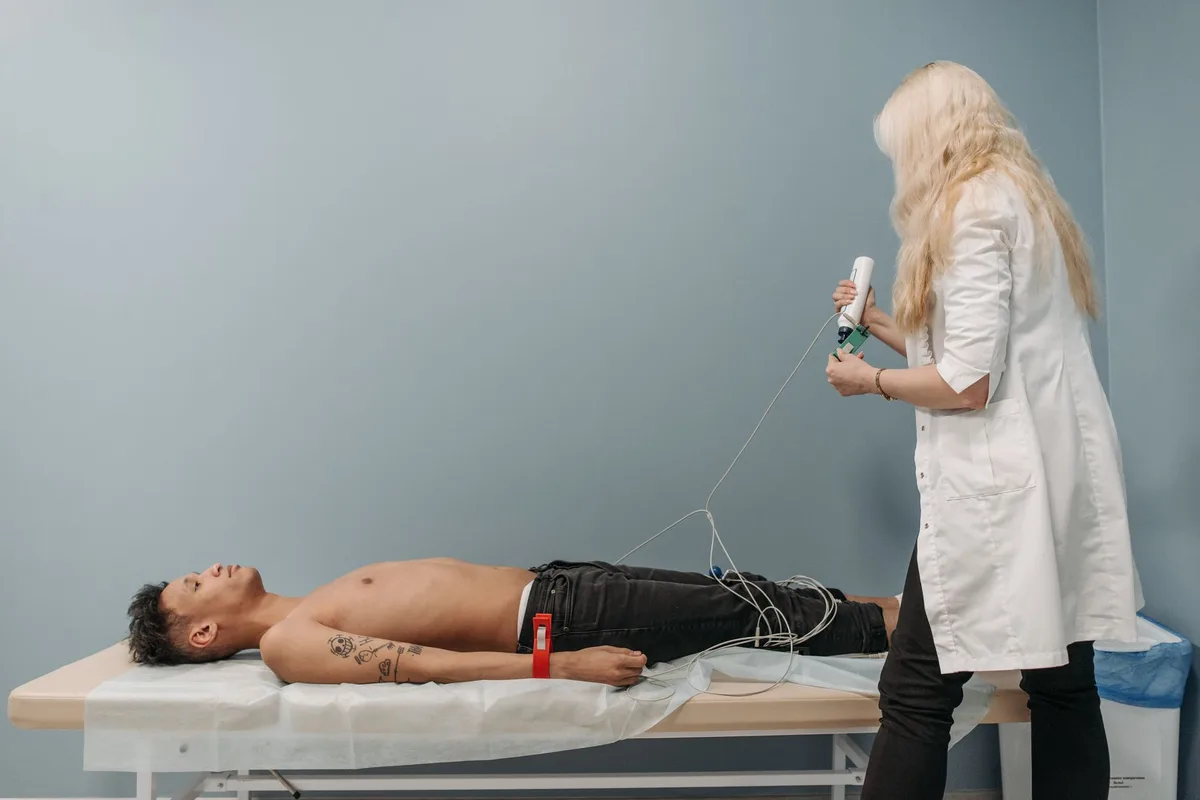
- A physical examination with hands on you. Provocation tests for the facet joints, the sacroiliac joint and the hip. A nerve-root exam for strength, reflexes and sensation. A look at how you stand up from the chair and walk to the door.
- Your imaging on the screen, read in front of you. Dr. Gurpreet Singh Padda, MD, MBA, MHP reads it himself. He tells you which findings match your examination. He also tells you which are the ordinary wear of a spine your age that is not causing anything.
- Bloodwork ordered, and usually drawn here. Fasting insulin, glucose and A1C, lipids, inflammatory markers, vitamin D and thyroid, because the terrain decides how fast anything heals.
- A named working diagnosis and a named test. You leave knowing which structure we suspect and which diagnostic block will confirm or reject it. You know what a positive result would lead to, and what we do if it is negative.
Will I get an injection at my first pain management visit?
Facet pain, sacroiliac pain and discogenic (disc) pain can produce the same low back ache and the same MRI. The scan cannot tell them apart. Neither can a good examination on its own. Comparative local anesthetic blocks are the only test with shown validity for the spine. A single uncontrolled block has a false-positive rate high enough to send a radiofrequency ablation at the wrong joint. So the first visit ends with a plan for the block, and the block is the second trip. Doing it on day one, before the examination has narrowed the target and before your plan has authorized it, is how patients accumulate injections that were never aimed at the right structure. The post what a diagnostic block tells you explains how the result is read.
Why does a pain doctor ask about sleep, food and who is at home?
You will be asked how many hours you sleep and whether they are in one stretch, because sleep loss lowers the pain threshold the next day and pain breaks up sleep the next night. In the adult population studied, that loop runs in both directions. You will be asked what you eat on a twelve-hour shift at the refinery or a night run out of the warehouses off I-255, because a diet of acellular carbohydrates and industrial seed oils keeps insulin high and keeps the immune cells around an injured nerve root active. You will be asked who is at home. Isolation is not a footnote in chronic pain. It is one of the drivers, and it is the one the system never asks about. Acceptance and Commitment Therapy, delivered in-house by a licensed pain-trained behavioral clinician, is part of the protocol for that reason. In the trials that studied it, ACT improved function and loosened the grip of pain on daily life in adults with chronic pain. It did so without asking anyone to pretend the pain was not real.
Fewer trips over the bridge
Because most of our patients drive from Madison, St. Clair or Monroe County, the plan is staged to save trips. The first visit does the diagnostic work in one sitting. Bloodwork results, the response to a block and medication changes are handled by phone or by video where that is clinically appropriate. Dr. Padda’s Illinois license allows that for a patient sitting at home in Illinois. The examination and the procedures cannot be done over a screen, and we will not pretend otherwise. If a device trial or an implant is the eventual answer, the operating-room part can be scheduled at Anderson Hospital in Maryville under his privileges there.
One more thing said plainly: a prior authorization from your plan is not a promise of payment. We verify benefits before the first visit and tell you what the plan said, and if a service is not covered you will be told before it is done, not after.
What happens if I am already taking pain medication?
Bring the bottles. Nobody is cut off at the first visit and nobody is refilled at the first visit; the first visit is a diagnosis. If a controlled medication turns out to be part of your plan, then monitoring is part of it as well. That includes toxicology testing and the prescription records available to us, because dosing a drug safely requires knowing what else is on board. The taper, when it comes, follows the procedures. Read opioid stewardship before you come if this applies to you.
Common questions
What should I not tell a pain management doctor?
Nothing. The examination is wasted if the history is edited. The medication history in particular has to be complete for anything to be dosed safely. A patient who tells us everything, including the drink after the night shift, gets a better plan. Sleep, movement and behavior shows why those details change the treatment.
What is the golden rule of pain management?
Find the pain source before you treat it, and treat the terrain at the same time. An injection aimed by a scan alone is a guess. One aimed by a positive medial branch block is a diagnosis.
Can I drive myself home from the first visit?
The first visit involves no procedure and no sedation, so driving yourself back over the bridge is fine. Procedure days are different for some blocks because a numbed leg does not work a brake pedal; driving home after a spine injection covers which ones.
Why is there a blood draw at a pain appointment?
Because fewer than 1% of this clinic’s chronic pain patients are metabolically healthy, and a high fasting insulin changes how a disc heals, how a steroid behaves and how a nerve fires. The post why a pain clinic checks your blood sugar goes through each mechanism.
How long is the first visit?
Plan for about an hour with the physician, plus time for the blood draw. Patients coming from Highland or Columbia should treat it as a half day with the drive. We schedule for that.
Do pain management doctors drug test on the first visit?
The first visit is a diagnosis, so nobody is cut off and nobody is refilled that day. Bring every bottle anyway. If a controlled medication turns out to be part of your plan, monitoring becomes part of it too, including toxicology testing and a check of the prescription records available to us, because dosing a drug safely requires knowing what else is on board.
Can follow-up visits be done by phone or video from Illinois?
Some can. Bloodwork results, the response to a diagnostic block and medication changes are handled by phone or video where that is clinically appropriate. Dr. Padda’s Illinois license covers a patient sitting at home in Illinois. The examination and the procedures cannot be done over a screen, so those still mean a trip across the bridge.
Will my insurance cover the first visit?
Benefits are verified before the first visit, and you are told what your plan said. If a service is not covered, you hear that before it is done, not after. One thing to know going in: a prior authorization from your plan is an approval to proceed, not a promise of payment.
How much does a pain management appointment cost?
What you pay is set by your plan’s deductible, copay and coinsurance, and the benefits check above is where that number comes from; an Illinois card is read by the same rules on this side of the river. If you are uninsured or choose not to use insurance, federal law gives you the right to a written Good Faith Estimate of the expected cost before a scheduled service. Ask for it when you book and keep the copy. A consultation, a diagnostic block and the bloodwork can each fall under a different line of the same plan, so ask about each one by name rather than about “pain management” as a whole. Learn more: planning the first trip across the river.
Related reading
- Your first visit, from Illinois
- For Illinois patients
- What a diagnostic block tells you
- Metabolic health and pain
- When it is an emergency
Nothing will be done to you that has not first been explained to you
Book the first visit, send the imaging ahead, and come with the unedited story. If the drive is long, say so when you call and the visit will be built around it.
505 Buckeye Dr, Suite 200
Troy, IL 62294
Procedure clinic: 4499 Woodson Rd, St. Louis, MO 63134, off I-70 next to St. Louis Lambert International Airport. One bridge from the Metro East.
Sources
- Bogduk N. On the validity and clinical utility of comparative local anesthetic blocks for the diagnosis of spine pain. Interventional Pain Medicine, 2023. PubMed 39238664
- Cohen SP et al. Pathogenesis, diagnosis, and treatment of lumbar zygapophysial (facet) joint pain. Anesthesiology, 2007. PubMed 17325518
- Hughes LS et al. Acceptance and Commitment Therapy (ACT) for Chronic Pain: A Systematic Review and Meta-Analyses. Clinical Journal of Pain, 2017. PubMed 27479642
- Finan PH et al. The association of sleep and pain: an update and a path forward. Journal of Pain, 2013. PubMed 24290442
- Dowell D et al. CDC Clinical Practice Guideline for Prescribing Opioids for Pain — United States, 2022. MMWR Recommendations and Reports, 2022. PubMed 36327391