Peripheral neuropathy · Metro East, IL
With diabetic neuropathy, your feet went numb years before anyone called your blood sugar a problem. The order of those two events is the diagnosis.
Diabetic neuropathy is a metabolic injury to the longest nerves in the body. It is usually under way years before the A1C crosses a line. We treat the pain, and we treat the chemistry that is still causing it.
Why does neuropathy start in the feet?
A single sensory nerve fiber runs from the skin of your big toe to the spinal cord in your lower back. That is about a meter in one cell. Fuel and repair material are shipped down its whole length by mitochondria (the cell’s power plants). The far tip is the hardest to supply and the first to go quiet. That is why the damage starts in the toes and climbs both legs at the same pace. By mid-calf it usually reaches the fingertips.
Thin fibers die first: burning, pins and needles, a sock that feels rolled under the arch, skin that hates the bedsheet. Thick fibers follow: numbness, a curb you did not feel. The American Diabetes Association asks for screening the day type 2 diabetes is diagnosed. It asks for it earlier when prediabetes has symptoms, because the injury usually comes before the label. Most people we see from the Metro East were never screened.
What causes diabetic peripheral neuropathy?
Two things damage the nerve, and sugar is only one. High glucose that stays high floods the axon (the nerve’s long wire) and its Schwann cells (its support cells) with more fuel than they can burn cleanly. The overflow becomes sorbitol, glycated proteins and free radicals. The second driver is fat. Long-term high insulin and triglycerides push saturated fatty acids into a Schwann cell built to burn them in small amounts. And the tiny vessels feeding the nerve stiffen and thin. That is lipotoxicity (fat poisoning), and it explains what the sugar-only model cannot.
In a Michigan cohort of obese adults from a weight-management program, polyneuropathy was already common in people with normal blood sugar. It was about as common with prediabetes as with diabetes. A Danish cohort followed 5,249 adults newly diagnosed with type 2 diabetes. Waist size, triglycerides and inactivity each tracked with neuropathy in adjusted models, not just the glucose. The nerve is responding to insulin resistance, which was there a decade before the diagnosis.
The third driver is not biological. A rotating shift at the refinery, a 4 a.m. start at the warehouse, dinner from a bag on the drive home: each fragments sleep, and a few short nights measurably raise insulin resistance. An employer writes the schedule and an industry writes the food. The nerve pays for both. Dr. Gurpreet Singh Padda, MD, MBA, MHP spent years telling patients with an A1C of 5.9 that their numbers were not too bad. He was wrong. Their feet were already taking the damage that number hides. That is why bloodwork here includes a fasting insulin and a lipid panel, not just a glucose.
How is peripheral neuropathy diagnosed?
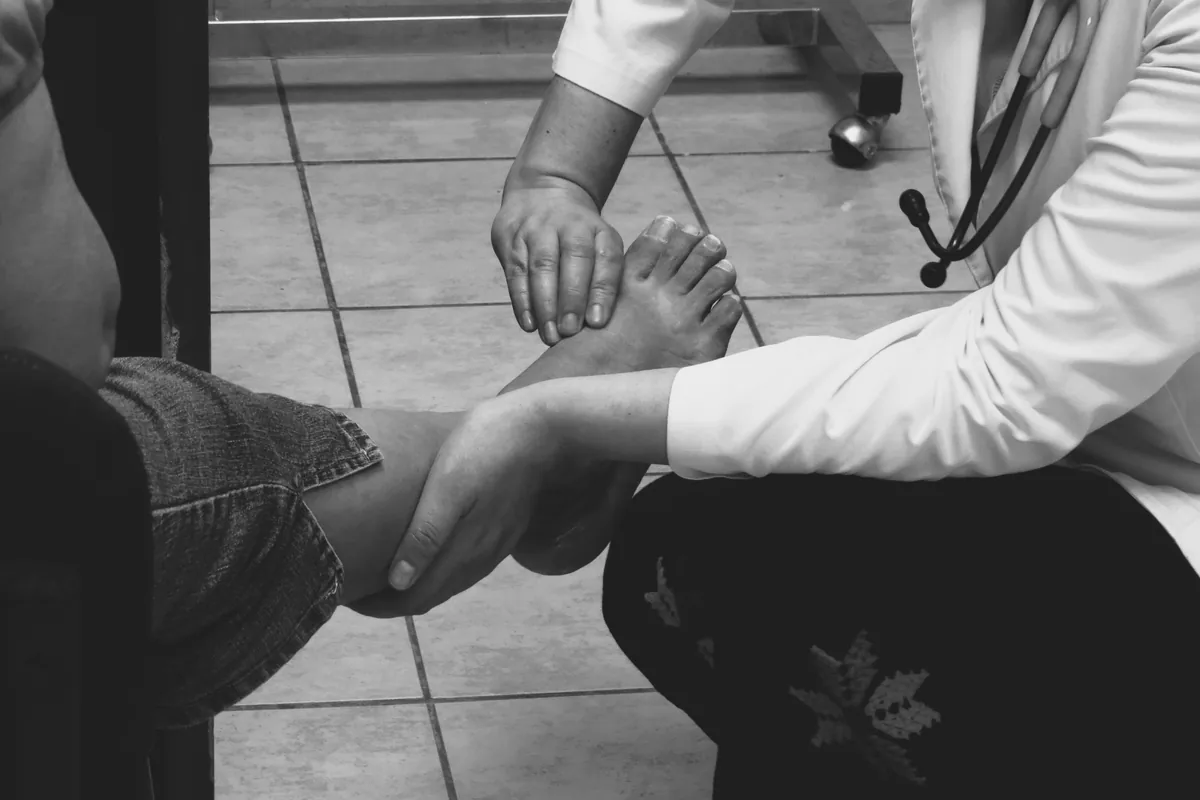
A monofilament on the sole, a tuning fork on the ankle bone, a hammer at the Achilles, and a map of where feeling changes. The exam answers one question. Is this even on both sides and worst at the far end, a metabolic neuropathy? Or is it one-sided and shaped like a nerve root, a spine problem? Many people over sixty carry both. An MRI showing lumbar stenosis will happily take the blame for feet being damaged from the inside. The bloodwork is part of the exam. We check A1C and fasting insulin, lipids, thyroid and kidney function. We check vitamin B12, because metformin drains it, and low B12 both mimics and worsens a diabetic neuropathy.
WHEN THIS IS NOT THE RIGHT PAGE
Numbness that spread over days, not years. Weakness as the main complaint, or a foot that slaps when you walk. One side only. A wound on the foot you did not feel happen, or a foot that is hot, red and swollen with no injury you remember. Weight loss you did not try for. Any change in bladder or bowel control. Each needs a different door, and some need it today. This page says which.
What is the best treatment for peripheral neuropathy?
THE TERRAIN, FIRST
Food, timing, walking and sleep are prescribed with the same seriousness as a device, because each has a mechanism. Removing acellular carbohydrates and industrial seed oils lowers the insulin and triglyceride load the Schwann cell is drowning in. A daily walk pulls glucose out of the blood through working muscle without needing insulin. It also drives blood through the vessels feeding the nerve. For the signal itself, the ADA statement supports pregabalin or duloxetine first, with gabapentin and tricyclics as other options. It does not recommend opioids as first- or second-line agents. Those drugs turn down the broadcast. They do not change the chemistry.
THE STIMULATOR AT THE EAR
The NS-100, an FDA-cleared Class II auricular peripheral nerve stimulator, is placed at the ear, not on the painful leg. It goes on in the office under topical anesthetic in about half an hour. It is worn up to 30 days, most patients about 20, with no sedation, no driver, no activity restriction and nothing left implanted. The evidence must be labeled. The published series is a retrospective, uncontrolled chart review of 83 Native American adults with type 2 diabetes and severe neuropathic pain. Pain scores fell from about 8 out of 10 to about 1 over 90 days, and A1C fell alongside. The authors themselves name placebo effect and regression to the mean as things the design could not exclude. We offer it with that label attached.
SPINAL CORD STIMULATION, WHEN THE REST IS NOT ENOUGH
A randomized trial took 216 patients with painful diabetic neuropathy refractory to medication (pain that drugs did not control). High-frequency spinal cord stimulation added to usual care produced a responder rate around four in five at three months. Usual care alone produced roughly one in twenty. It is a trial before an implant. Surgery is not part of the plan for diabetic peripheral neuropathy. The injury is spread out, and there is no single structure to decompress.
Why do sleep and daily habits matter for neuropathy?
Here is the loop. Burning feet keep you awake. Short sleep raises cortisol and insulin resistance. Glucose runs higher. The nerve takes more damage, and the next night is worse. Breaking that loop is a treatment target. That is why roughly 40 to 50 percent of this practice’s protocol involves no device. Acceptance and Commitment Therapy is delivered in-house by a licensed, pain-trained behavioral clinician. It targets the habits that feed the chemistry: the skipped walk, the 1 a.m. scroll, the skipped meal followed by the large one.
Doing this from the Illinois side of the river
Neuropathy is a condition of many small adjustments, and a long drive for each one is why people quit. So the first visit does the most work: the exam, the full panel drawn on site, and a plan you leave with. Metabolic follow-up can run by telehealth where clinically appropriate. The ear device is placed and removed as one pair of trips. Granite City to the door is about 25 minutes without traffic by I-270 and the Chain of Rocks. Belleville is about 40 by I-64 and I-170 north. If you cannot feel the brake pedal, tell us; it changes how we schedule you.
Frequently asked questions
Can I book a neuropathy visit without a referral?
Yes. No referral is needed to be seen here. Some insurance plans want one from your primary doctor before they pay, so check your plan. Neuropathy is often a blood sugar story told late, and blood tests for inflammation covers the labs we order.
Can diabetic neuropathy be reversed?
Thin-fiber damage caught early can improve when insulin resistance and triglycerides come down. That is because Schwann cells and small vessels recover once the load is removed. Thick-fiber loss present for years mostly does not. The metabolic work decides whether the damage keeps advancing.
Why is it so much worse at night?
Lying still removes the input from walking and pressure that normally drowns out damaged fibers. A warm blanket irritates thin fibers. And cortisol is at its daily low. The answer is partly medicine and partly the sleep and movement work that makes the night shorter and the day more active.
Is the ear device the same as a peripheral nerve stimulator on the leg?
Different devices for different problems. The auricular device sits at the ear and treats diabetic neuropathy across both feet. A peripheral nerve stimulator sits beside one named nerve causing pain in one place, after a diagnostic block has proven which nerve that is.
How do you stop peripheral neuropathy from progressing?
Lower the load that is damaging the nerve. That means bringing down insulin resistance and triglycerides, not just glucose. Cut acellular carbohydrates and industrial seed oils, walk every day, and protect sleep. Bloodwork here includes a fasting insulin and a lipid panel for that reason. Thin-fiber damage caught early can improve once the load comes off. Numbness present for years mostly does not.
What foods should you avoid with neuropathy?
The two we name first are acellular carbohydrates and industrial seed oils. Both raise the insulin and triglyceride load that the nerve’s support cells are drowning in. Dinner from a bag on the drive home, or a skipped meal followed by a large one, feeds the same chemistry. Food, meal timing, walking and sleep are prescribed together, with the same seriousness as a device.
How do you calm neuropathy pain in your feet?
For the burning itself, the American Diabetes Association statement supports pregabalin or duloxetine first, with gabapentin and tricyclics as other options. It does not recommend opioids as first- or second-line drugs. Those medicines turn the signal down but do not change the chemistry. When feet still burn, the ear stimulator is an option. Spinal cord stimulation is considered when the rest is not enough.
Do I need a neurologist before a pain doctor treats my neuropathy?
Not to be seen here. Sorting a metabolic neuropathy from spinal stenosis or a vitamin deficiency is part of the first visit, and electrodiagnostic testing is ordered when one foot behaves differently from the other or the spine is a suspect. If that workup turns up a pattern that belongs with a neurologist, the referral carries the finding, the bloodwork and the test results, so the next appointment starts where this one ended. The Belleville page walks through the four common causes of burning feet that the workup has to separate. Learn more: why the first visit measures blood sugar and insulin.
Related reading
- Metabolic health and pain
- Peripheral nerve stimulation
- Spinal cord stimulation
- Spinal stenosis
- Sleep, movement and behavior
- Why a pain clinic checks your blood sugar
- Plantar fasciitis
- Golfer’s elbow
Sources
- Pop-Busui R et al. Diabetic Neuropathy: A Position Statement by the American Diabetes Association. Diabetes Care, 2017. PubMed 27999003
- Callaghan BC et al. Association Between Metabolic Syndrome Components and Polyneuropathy in an Obese Population. JAMA Neurology, 2016. PubMed 27802497
- Christensen DH et al. Metabolic Factors, Lifestyle Habits, and Possible Polyneuropathy in Early Type 2 Diabetes: A Nationwide Study of 5,249 Patients in the Danish Centre for Strategic Research in Type 2 Diabetes (DD2) Cohort. Diabetes Care, 2020. PubMed 32295810
- Staats PS et al. Combined minimally invasive vagal cranial nerve and trigeminocervical complex peripheral nerve stimulation produces prolonged improvement of severe painful peripheral neuropathy and hyperglycemia in type 2 diabetes. Frontiers in Neuroscience, 2025. PubMed 40933195
- Petersen EA et al. Effect of High-frequency (10-kHz) Spinal Cord Stimulation in Patients With Painful Diabetic Neuropathy: A Randomized Clinical Trial. JAMA Neurology, 2021. PubMed 33818600
You will hear what the nerve is doing and what your bloodwork is doing in the same visit
We will tell you which fibers are affected, what the panel says about why, and what each part of the plan is for. If the terrain matters more than any device, that is what you will hear first.
505 Buckeye Dr, Suite 200
Troy, IL 62294
Procedure clinic: 4499 Woodson Rd, St. Louis, MO 63134, off I-70 next to St. Louis Lambert International Airport. One bridge from the Metro East.