Dr. Padda · Pain physician
He learned surgery at Cook County, anesthesia at Barnes, and the metabolic side of pain the hard way, from twenty years of his own patients.
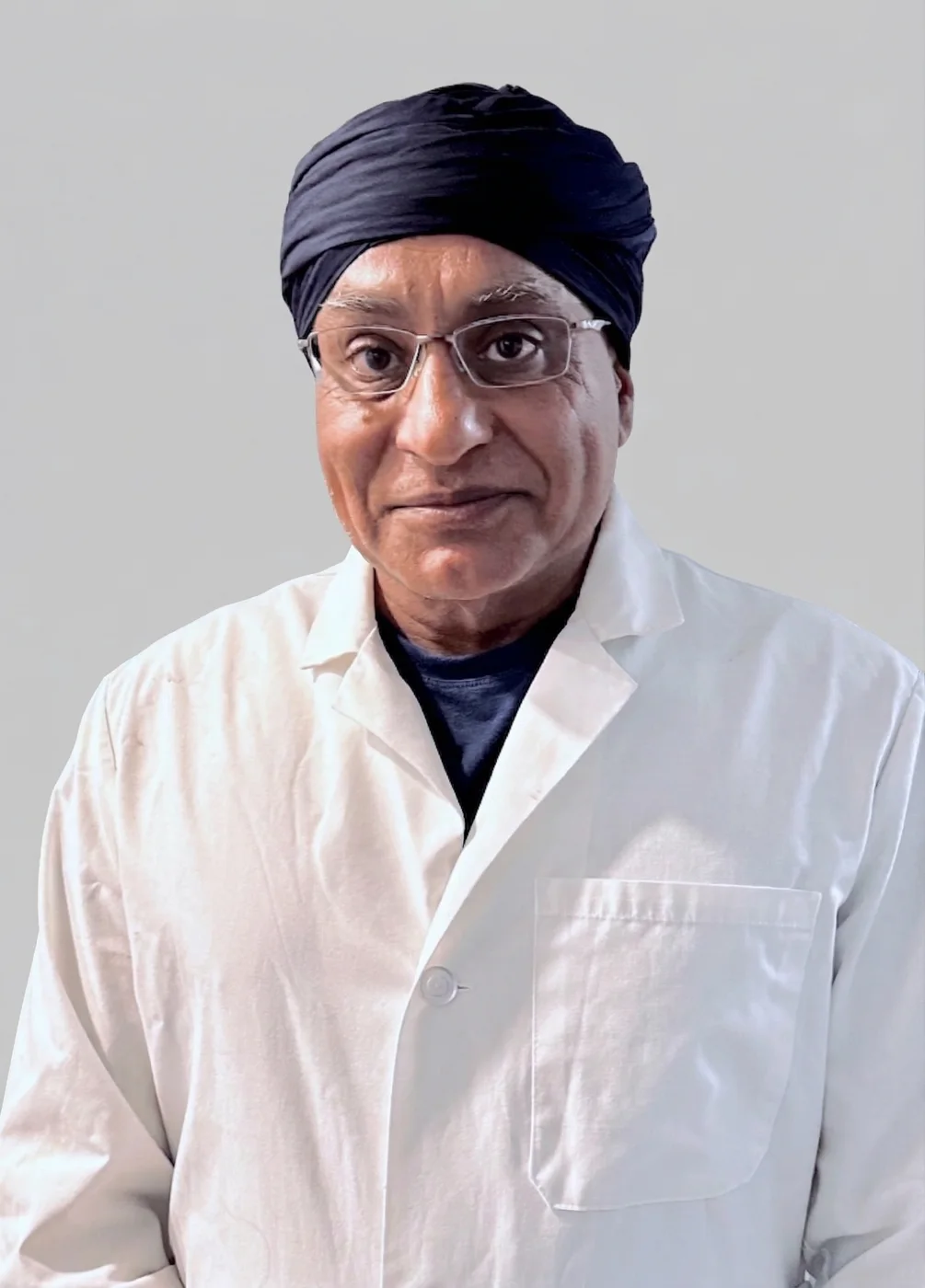
Dr. Gurpreet Singh Padda, MD, MBA, MHP is the medical director: anesthesiologist and interventional pain physician, diplomate in addiction and obesity medicine, licensed in Illinois and Missouri, on staff at Anderson Hospital in Maryville.
Where did Dr. Padda train?
Dr. Padda took his biology degree and his medical degree at the University of Missouri–Kansas City in a combined program from 1982 to 1988. Then he went to Chicago. His first residency year was general surgery at Cook County Hospital with the University of Illinois at Chicago, the busiest trauma service in the state. An anesthesia year at Illinois Masonic came next. He finished anesthesia at Washington University and Barnes Hospital in St. Louis from 1990 to 1992, with pediatric anesthesia at St. Louis Children’s, and was chief resident in his final year. The surgery year shapes how he practices now. He thinks about a spine the way a surgeon does. That is why he will say when an operation is the right answer, and why he will not pretend an injection is one when it is not.
He added an MBA in international business at Saint Louis University in 1998 and certification as a physician executive the same year. That is not decoration. It is the reason this practice reads a pain problem as a system problem. We follow the incentive that produced it. And we count what a treatment costs a patient in time, function and money as part of the medical decision.
What he got wrong first
For roughly twenty years he told pre-diabetic patients their A1C was not too bad, injected their spines, and sent them home. He was a conventionally trained doctor doing what the guidelines said. For a long time he was also a strict vegetarian, defending the same guidelines at his own table. The patients did not get better the way the textbooks promised. The injections worked for a while, then the pain came back. And the numbers he had called not too bad kept drifting in one direction.
The correction came from the physiology, not from a conference. Hyperinsulinemia (too much insulin in the blood) and metabolic inflammation sensitize nerves. They starve the tiny blood vessels that a healing disc or joint depends on. They keep the immune response around an injury switched on. A patient whose fasting insulin is high does not heal on the schedule a trial of healthy volunteers predicts. Once he understood that, chronic pain, obesity, type 2 diabetes and addiction stopped looking like four diseases. They started looking like one collision with one shared engine. Under 7% of United States adults are metabolically healthy on the tighter criteria applied after 2021, down from under 12.2% on NHANES 2009–2016. In this clinic’s population it is under 3%. He now treats the terrain and the generator at the same time, and he says so in the first visit.
What is Dr. Padda board certified in?
Board certified in anesthesiology, pain medicine and interventional pain management, a diplomate in addiction medicine and in obesity medicine, a certified Metabolic Health Practitioner and a Fellow of Interventional Pain Physicians. Added competency certifications in coding, compliance and practice management, controlled substance management, nutrition and regenerative medicine in interventional pain. The length of the list is the point. A patient with a herniated disc, a fasting glucose creeping upward, six years on an opioid and a shift schedule that has wrecked their sleep does not need four specialists who each own a quarter of the problem. They need one physician who is credentialed in all of it and treats it in one room.
Academic and leadership record
- Assistant Professor of Anesthesiology (1992–99) and of Pediatrics (1993–99) at Saint Louis University and Cardinal Glennon; Associate Director of Pediatric Anesthesiology and Director of the Pediatric Acute Pain Management Service; Deputy Director of the university’s Institutional Review Board.
- Chairman of Anesthesia, Perioperative Medicine and Pain Management at two St. Louis hospitals; Regional Director for a multi-hospital anesthesia group; founder and Chief Medical Officer of the Center for Interventional Pain Management since 2001; Director of an ambulatory surgery center from 2017 to 2023.
- President of the Missouri Society of Interventional Pain Physicians (2002–10 and again since 2023); board member and examiner for the American Board of Interventional Pain Physicians; ASIPP Board of Directors (2008–10); faculty in pain and addiction for a psychiatry residency program since 2024.
- Two ASIPP keynotes on metabolic inflammation and interventional pain (2020, 2021), an ASIPP 2025 lecture on outcome measurement, and a 2025 metabolic health lecture for the Society of Metabolic Health Practitioners. Peer-reviewed publications in Neuromodulation, Pain Medicine, Critical Care Medicine, Anesthesia & Analgesia and Pain Physician; review editor for PharmacoEconomics; coauthor of the 2023 bestseller Next Level Your Life.
Where does Dr. Padda see Illinois patients?
Dr. Padda is licensed in Illinois and is on the medical staff of Anderson Hospital in Maryville with full privileges in pain management, anesthesiology, surgery and addiction medicine. In practice that means the procedures that belong in an operating room, such as a stimulator implant, a pump or a nerve decompression, can be scheduled on the Illinois side for a patient from Madison or St. Clair County, and that his hospital relationship on your side of the river is a working one. It does not mean there is an office there. Diagnostic blocks and image-guided procedures happen at 4499 Woodson Rd in St. Louis; the practice also keeps an Illinois office at 505 Buckeye Dr, Suite 200, in Troy, and the office will tell you which address your visit is scheduled at, one bridge over. He is also on staff at SSM Health St. Clare Hospital in Fenton.
What is Dr. Padda like with patients?
“I usually start off my conversation with: you’re probably going to call me an asshole, but this is what we need to do. You’re not going to like me in the process, but you’re going to like me at the end.”
Dr. Padda, on the first visit
That is the reassurance, not the warning. A patient who has been managed politely for years reads politeness as dismissal. He will tell you what the bloodwork says and what the sleep schedule is doing to your spinal cord. He will tell you the injection is what makes the treatment possible, not the treatment itself. Lifestyle and behavior are 40 to 50 percent of the plan here. Every instruction comes with a body-based reason. Acceptance and Commitment Therapy is provided in-house by a licensed, pain-trained behavioral clinician. Read the mechanism at metabolic health and pain.
Seva
Seva means service done without expecting return, credit or exchange. It is the reason he founded the Sevadar Foundation, a 501(c)(3) he funds himself. Its programs cover patient safety, opioid safety, and care for veterans and neighbors without housing. Seva is also the reason he has worked medical missions in Honduras, Guatemala and Nicaragua. It is why there are no drug company reps in this clinic, and why a patient is never treated as a billing event. Medicine is a duty owed. The rest of this site is written on that belief.
For more information, our page on knee pain offers the free knee guide. It explains your X-ray and your treatment options in plain English.
Frequently asked questions
Is Dr. Padda licensed to treat patients from Illinois?
He holds an Illinois medical license and a Missouri one, and he is on staff at Anderson Hospital in Maryville. What that changes for records, insurance and follow-up is laid out in for Illinois patients.
Who actually performs the procedure?
Dr. Padda does. He is also the doctor who examined you and read your imaging, so the block is aimed by the person who made the diagnosis. What to expect describes how that first hour runs.
Why is an anesthesiologist treating my back?
Interventional pain medicine grew out of anesthesiology because the skills are the same: placing a needle beside a nerve under imaging, with a drug whose dose and spread you understand. A medial branch block is a small anesthetic procedure that happens to answer a large diagnostic question.
Does the addiction medicine certification mean this is an addiction clinic?
It means a patient who arrives already dependent on an opioid is treated by someone trained and certified to manage the taper safely while procedures take over the pain. That patient is not refused or abandoned. The approach is written out at opioid stewardship.
Will he tell me if I need surgery?
Weakness that is spreading, or a fracture that is unstable, is a surgical conversation, and he will have it with you directly. For most patients whose earlier operation did not end the pain, the more useful talk is about what the operation could never have reached.
What kind of doctor is best for pain management?
For pain that comes from a specific joint, disc or nerve, see an interventional pain physician. That is a doctor trained, usually through anesthesiology, to place a needle beside a nerve under imaging. The needle is used both to find where the pain starts and to treat it. When the pain comes with rising blood sugar, wrecked sleep or years on an opioid, it helps if the same doctor is certified in metabolic and addiction medicine. Then the whole problem is treated in one room.
What hospitals is Dr. Padda affiliated with?
On the Illinois side, he is on the medical staff of Anderson Hospital in Maryville, with full privileges in pain management, anesthesiology, surgery and addiction medicine. That is where operating-room procedures such as a stimulator implant, a pump or a nerve decompression can be scheduled for a Madison or St. Clair County patient. He is also on staff at SSM Health St. Clare Hospital in Fenton, Missouri.
What should I bring to my first visit with Dr. Padda?
Bring your imaging, your medication list, and a list of the things you have stopped doing because of the pain. The first visit is a diagnosis, made by the doctor who will treat you. Expect him to tell you plainly what the bloodwork says and what your sleep is doing to the pain. The office will tell you whether your visit is at 4499 Woodson Rd in St. Louis or the Troy, Illinois office.
Related reading
- What to expect on the first visit
- For Illinois patients
- Metabolic health and pain
- For referring physicians
- Opioid stewardship
- Orthobiologics: the regenerative side of the practice
BOARD CERTIFICATIONS, SOCIETIES AND AFFILIATIONS



You will be told what he thinks, and why, in plain words
Bring the imaging and the medication list and the list of things you have stopped doing. The first visit is a diagnosis, made by the physician who will treat you, and it is built to be worth the drive from the Metro East.
505 Buckeye Dr, Suite 200
Troy, IL 62294
Procedure clinic: 4499 Woodson Rd, St. Louis, MO 63134, off I-70 next to St. Louis Lambert International Airport. One bridge from the Metro East.
As Seen In
Our releases ran on AP News, The National Law Review, FOX 2 St. Louis and 570+ other news sites across the United States and Canada.
- 12press releases
- 4,600+news placements
- 580+news outlets
- 110+TV station sites
- AP News
- The National Law Review
- FOX 2 St. Louis
- WGN-TV Chicago
- PIX11 New York
- KRON 4 San Francisco
- Detroit Free Press
- The Detroit News
- The Indianapolis Star
- The Tennessean
- Milwaukee Journal Sentinel
- The Arizona Republic
- The Des Moines Register
- The Cincinnati Enquirer
Distributed by EIN Presswire for Nectar Media Group.
In the press
- Dr. Gurpreet Singh Padda, MD: Trial Suggests PRP May Delay Knee Replacement for Patients Already on the Surgical List
EIN Presswire, October 12, 2026. Sets out, for World Arthritis Day, what a randomized trial says about PRP for patients already waiting on a knee replacement, and why he calls it a bridge rather than a cure. - Dr. Gurpreet Singh Padda, MD Puts the New Low-Carb Guideline to Work in Pain Care: Medicines Change Before Pain Does
EIN Presswire, October 7, 2026. Describes how the new low-carb guideline shapes his changes to blood pressure, diabetes and pain medicines for patients on both sides of the river.
Sources
- O’Hearn M et al. Trends and Disparities in Cardiometabolic Health Among U.S. Adults, 1999–2018. Journal of the American College of Cardiology, 2022. PubMed 35798448
- Araújo J et al. Prevalence of Optimal Metabolic Health in American Adults: National Health and Nutrition Examination Survey 2009–2016. Metabolic Syndrome and Related Disorders, 2019. PubMed 30484738
- American Society of Interventional Pain Physicians. asipp.org

