Hip pain treatment · Metro East
Your hip and your lower back have been blamed for each other’s pain for forty years. There is a name for it, and an exam that sorts it.
Hip-spine syndrome was described in 1983 and is still missed every week. We examine the hip, the spine and the tendons on the side of the hip before any of them is injected. That is because the wrong one gets treated often enough to have its own literature.
Where is my hip pain actually coming from?
When a patient says hip, they may mean any of three things. The treatment for each is different. The ball-and-socket joint itself sits deep in the front of the groin. Pain from it is felt there and down the front of the thigh toward the knee. The tendons and bursa on the outer bony point of the hip cause pain on the side. It is worst lying on it at night and climbing stairs. And the lower spine, the sacroiliac joint and the gluteal muscles cause pain in the buttock that people routinely call hip pain. Two orthopedic surgeons named the overlap hip-spine syndrome in 1983. Over the last decade, a series of papers from a St. Louis physiatry group has shown how often an arthritic hip shows up at a spine clinic, and a spine problem at a hip clinic.
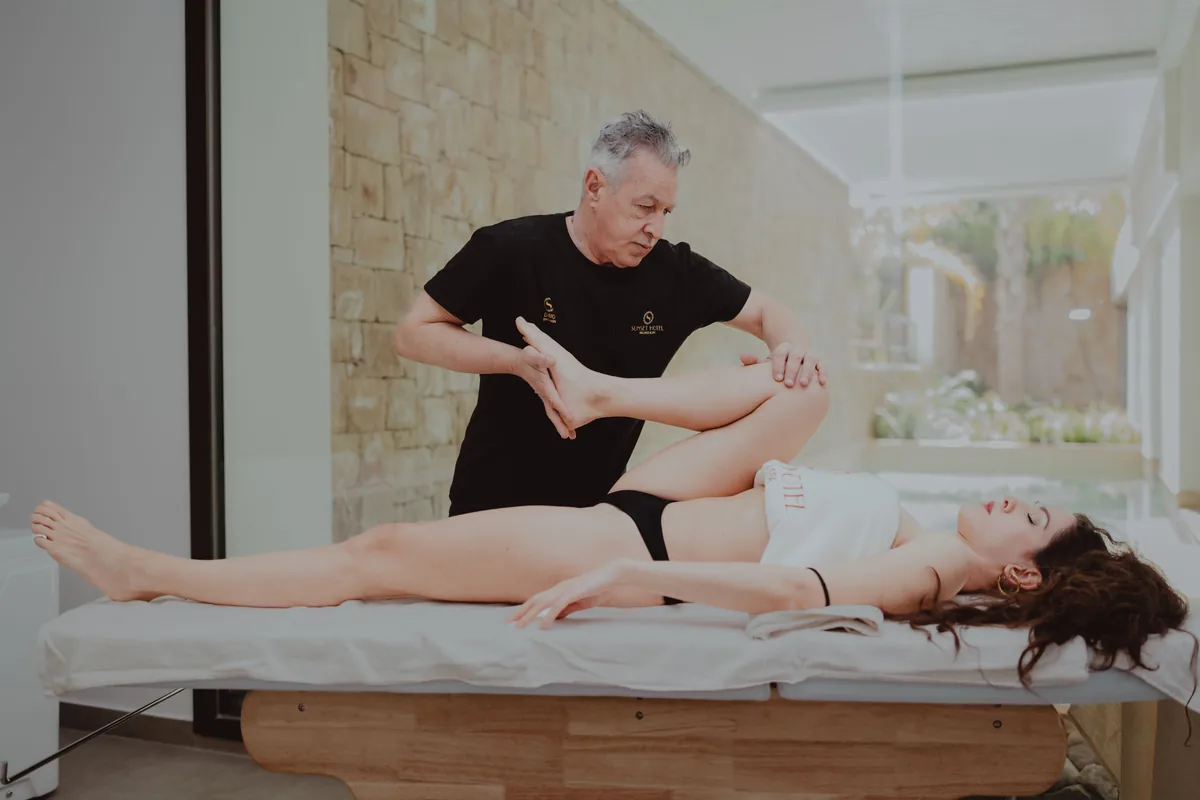
The confusion lasts because both hurt with walking and both hurt with sitting. And the MRI of either one will find something in anybody past forty-five. The exam is what sorts them. Rotating the hip with the knee bent. Rolling the leg on the table. Pressing the bony point on the side. The straight-leg raise. Standing on one leg while we watch the pelvis. Each test loads one structure and not the others. When the exam cannot settle it, a diagnostic injection can. That is a test with an answer within the hour.
What causes hip arthritis and hip tendon pain?
Hip osteoarthritis is partly load and partly chemistry. In a population cohort of more than 1.7 million adults, obesity raised the risk of hip osteoarthritis, less steeply than knee. It raised the risk of hand osteoarthritis too, and no one walks on their hands. The chemistry is insulin and inflammatory signals from fat tissue. They reach the cartilage through the bone beneath it. Add glycated collagen (collagen bound up by sugar) that has lost its spring. The tendon on the side of the hip fails the same way. Collagen cross-linked by long-term high glucose is stiffer and tears at lower loads. A large population study of the outer-hip pain syndrome found it clustered with low back pain and knee arthritis. Those are not coincidences. They are one terrain showing up in three tissues.
The third driver is how the hip is used. A truck cab, a forklift or a desk holds the hip bent for eight hours. That shortens the front of the joint and takes the load off the muscles that should steady it. Then the gluteal tendons absorb every step on concrete afterward. Sleeping on the painful side presses the tendon against the bone all night. Nobody in the Metro East chose the shift or the seat. The plan has to account for both, not pretend the hip lives alone.
A DIFFERENT DOOR, TODAY
Not being able to bear weight after a fall, especially past sixty-five. A hip that is hot and swollen with a fever. Groin pain in someone on long-term steroids or with heavy alcohol use, which can be the bone dying from inside. Night pain with unexplained weight loss or a cancer history. New numbness, weakness, or a change in bladder or bowel control. These need imaging and an emergency or orthopedic evaluation now; this page says where.
What is the treatment for hip pain?
THE DIAGNOSTIC INJECTION
Local anesthetic placed inside the hip joint under fluoroscopy (live X-ray) answers the question the MRI cannot. If the pain goes away for the afternoon, the joint was the source. If it does not, the joint was a bystander, and the spine or the sacroiliac joint gets tested next. The joint sits deep. A cadaver study of landmark-guided injections (placed by feel) found the needle missed it in a meaningful share of attempts. That is why every hip injection here is done under imaging. No sedation; you drive yourself home.
THE TERRAIN
Bloodwork on the first visit: A1C, fasting insulin, lipids, vitamin D. Then the prescriptions, with their reasons. Acellular carbohydrates and industrial seed oils come out, because they drive the insulin that is stiffening the collagen. Hip extension and gluteal loading come in, because a tendon rebuilds collagen only under graded strain, and a joint is fed by the pumping of movement. Sleep on the other side with a pillow between the knees, because the pressure on the tendon is what wakes you. A licensed, pain-trained behavioral clinician gives Acceptance and Commitment Therapy in-house, because the limp becomes a habit before the joint needs it. This is 40 to 50 percent of the protocol.
TREATING THE STRUCTURE THE TEST NAMED
For a confirmed joint: steroid for a short window, with the blood-glucose cost stated up front, or PRP [platelet-rich plasma, your own concentrated platelets], which most payers do not cover; that is a payer decision, not a verdict on the evidence. For the tendon on the side: a guided injection at the insertion, and a loading program that does most of the work. For a hip that still hurts after every conservative option, the small sensory nerves that report the joint can be blocked and, if the block works, treated with radiofrequency ablation. For a spine or sacroiliac source wearing a hip’s name, the plan moves to that page. Replacement, when it is the answer, is a good operation, and we want the joint that goes to the surgeon to be the one that needed it.
From the Illinois side, in as few trips as possible
Hip pain makes the drive itself part of the problem, so the first visit is built to carry the diagnosis as far as it can go: examination, bloodwork, and where the exam calls for it, the diagnostic injection the same day. Collinsville to the clinic is under 40 minutes without traffic by I-55/70 and the Poplar Street Bridge; O’Fallon is about 40 by I-64 to I-170 north. Set the seat back a notch, stop once to stand if it is a bad day, and tell us when you call that sitting is hard.
Orthobiologic treatment options
When the pain sits on the outer point of the hip, the tendon is usually the real target, not the bursa. A steroid shot calms it for a while. It does not rebuild it. PRP placed into the frayed gluteal tendon under ultrasound is aimed at the repair. It works best paired with side-hip strength work and a few changes in how you sit, stand and sleep. Our hip bursitis page walks through the evidence. That includes the trial that did not find a benefit, and why its preparation matters.
When the pain is deep in the groin, the hip joint itself is the target. PRP or bone marrow concentrate placed inside the capsule under image guidance is an option there, and the result rides on the platelet dose delivered and the rehab that follows. You stay awake under local anesthetic, and most people drive themselves home.
Common questions
Can I book a hip pain visit without a referral?
Yes. You schedule it yourself, by phone, text or online. Some plans, usually HMOs, still ask for a referral from your primary doctor before they pay, and we tell you before the visit if yours does. The first visit from Illinois walks through the day.
How do I know whether my hip pain is coming from my back?
Pain from the joint lives in the groin and the front of the thigh, and gets worse when you rotate the hip. Pain from the spine tends to live in the buttock, travel below the knee, and change with bending or sitting. The exam separates them most of the time. A diagnostic injection settles the rest; this article explains how that test is read.
Why does it hurt most when I lie on that side at night?
Lying on the hip presses the gluteal tendons and their bursa against the bony point for hours. A tendon whose collagen has been stiffened by high glucose handles that poorly. Sleep position is part of the plan. The sleep page explains the rest of why nights matter.
Will a hip injection tell me whether I need a replacement?
It tells you whether the joint is the source of the pain. That is the question a replacement has to answer first. An image-guided injection that wipes out the pain confirms the joint. One that does not saves you an operation aimed at the wrong structure.
Does my weight really matter if the X-ray already shows arthritis?
The X-ray shows cartilage that is gone. Pain tracks the inflammation in the joint lining. That rises and falls with insulin and inflammatory signals from fat tissue. That is what the metabolic work changes, and it changes faster than the X-ray does.
What is a red flag for hip pain?
Some hip pain should not wait for an appointment. Get imaging and an emergency or orthopedic evaluation now if you cannot bear weight after a fall, especially past sixty-five; if the hip is hot and swollen with a fever; if you have groin pain while on long-term steroids or with heavy alcohol use; if night pain comes with unexplained weight loss or a cancer history; or if you have new numbness, weakness, or bladder or bowel changes.
What is the best position to sleep in with hip pain?
If the pain is on the outer side of the hip, sleep on the other side with a pillow between your knees. Lying on the painful hip presses the gluteal tendons and their bursa against the bony point for hours. That pressure is what wakes you. Sleep position is written into the plan here, not left as an afterthought.
How can I tell if my hip pain is from the joint, a tendon or a muscle?
Location is the first clue. Pain from the ball-and-socket joint sits deep in the groin and runs down the front of the thigh. Pain from the tendons and bursa sits on the outer side of the hip and is worst lying on it or climbing stairs. Buttock pain often comes from the lower spine, the sacroiliac joint or the gluteal muscles. The exam tests each one, and a diagnostic injection settles the rest.
What is the best treatment for hip pain?
The one aimed at the right structure. A confirmed joint may get a short-window steroid injection or PRP under imaging. A tendon on the side of the hip gets a guided injection where it attaches, and a loading program that does most of the work. A hip that still hurts after every conservative option can have its sensory nerves blocked. If the block works, they can be treated with radiofrequency ablation.
Related reading
- Image-guided joint injections
- Sacroiliac joint pain
- Spinal stenosis
- Knee pain
- Metabolic health and pain
- Hip bursitis
- PRP injections and orthobiologics in the Metro East
Sources
- Offierski CM, MacNab I. Hip-spine syndrome. Spine, 1983. PubMed 6623198
- Prather H et al. Links between the Hip and the Lumbar Spine (Hip Spine Syndrome) as they Relate to Clinical Decision Making for Patients with Lumbopelvic Pain. PM&R, 2019. PubMed 31074168
- Segal NA et al. Greater trochanteric pain syndrome: epidemiology and associated factors. Archives of Physical Medicine and Rehabilitation, 2007. PubMed 17678660
- Leopold SS et al. Safety and efficacy of intraarticular hip injection using anatomic landmarks. Clinical Orthopaedics and Related Research, 2001. PubMed 11603669
- Reyes C et al. Association Between Overweight and Obesity and Risk of Clinically Diagnosed Knee, Hip, and Hand Osteoarthritis: A Population-Based Cohort Study. Arthritis and Rheumatology, 2016. PubMed 27059260
- Bannuru RR et al. OARSI guidelines for the non-surgical management of knee, hip, and polyarticular osteoarthritis. Osteoarthritis and Cartilage, 2019. PubMed 31278997
Nothing gets injected until the exam has named the structure
You will be told which of the three it is, how we know, and what the plan for that one is. If the answer is the spine and not the hip, you will hear it before anything is done to the hip.
505 Buckeye Dr, Suite 200
Troy, IL 62294
Procedure clinic: 4499 Woodson Rd, St. Louis, MO 63134, off I-70 next to St. Louis Lambert International Airport. One bridge from the Metro East.