Image-guided joint injections · Metro East IL
One image-guided joint injection that lands beats three blind ones that might have. In a joint, the count matters as much as the aim.
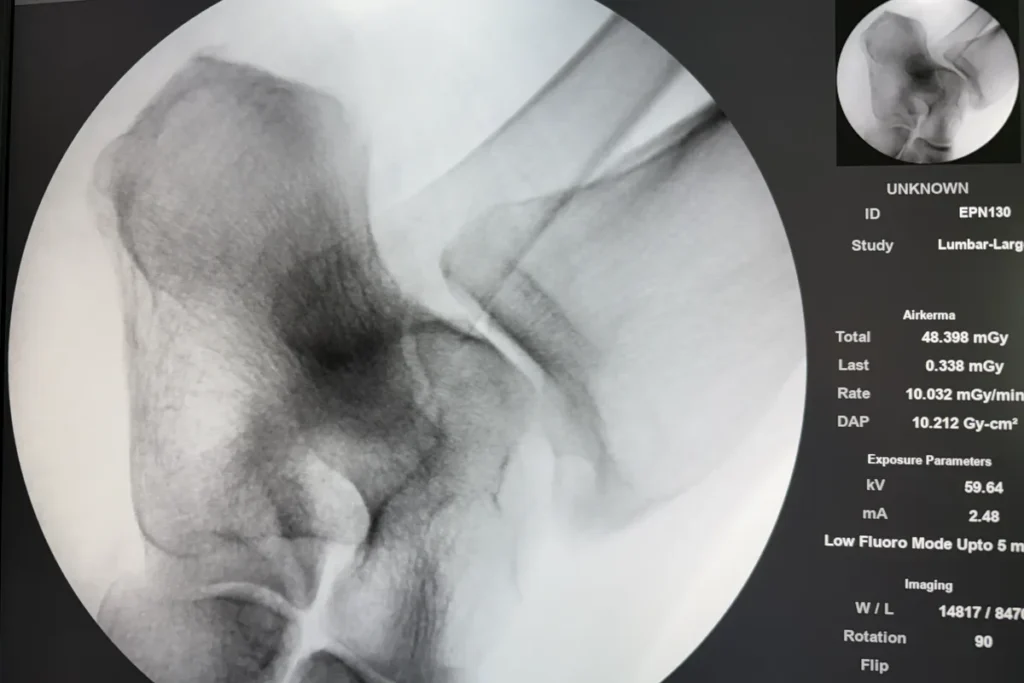
Image-guided joint injections in the hip, shoulder and knee use fluoroscopy or ultrasound to put the medication inside the joint capsule. Placement is confirmed on screen. So every injection answers a question, and none is spent on a miss.
Why does the number of joint injections matter?
Steroid in a joint is a good drug that has been handed out like a habit. One trial tested the habit. It enrolled 140 adults with symptomatic knee osteoarthritis and inflamed joint lining on ultrasound. They got either triamcinolone or saline into the knee every twelve weeks for two years. The steroid group lost more cartilage on MRI and had no less pain. Steroid also does not stay in the joint. Another study followed 70 diabetic patients who checked their sugar for two weeks after a steroid injection. Knee injections raised fasting glucose on the first two days. Hand, wrist and shoulder injections did not. And the higher the A1c going in, the bigger the rise.
So each injection costs the cartilage and the bloodstream something. A joint being worn down from the inside by high insulin and metabolic inflammation is exactly the joint that can least afford a wasted one. The third cost is the drive. From O’Fallon the office is about 40 minutes each way with no traffic. An injection means a day off a warehouse or hospital shift. A blind injection that lands in the muscle beside the hip capsule spends all three costs and answers nothing. That is the case for imaging, and for counting.
Why use image guidance for a joint injection?
The hip joint sits under several inches of muscle. Feel alone cannot tell the capsule from the tissue around it. The shoulder is shallower and still gets missed. Twelve randomized trials covered 891 patients with subacromial impingement (a pinched tendon in the shoulder). Ultrasound-guided steroid beat landmark-guided steroid on pain and function. The evidence was rated moderate to very low in certainty, and the edge was clearest at six to eight weeks. Under fluoroscopy, a drop of contrast outlines the capsule before anything else goes in. Under ultrasound, the needle tip is watched into the joint. Either way, you see the confirmation on the screen, and so do we.
Once the needle is truly in the joint, the injection becomes a test as well as a treatment. Local anesthetic in the hip and twenty minutes of walking answers a question a scan cannot. Is the hip the source, or a stand-in for the low back? Groin pain that vanishes with the hip numb is hip pain. Groin pain that does not is coming from somewhere else. Then the workup moves there, not to a second hip injection.
What is injected into the joint, and when is the joint not the source?
CORTICOSTEROID
Fast, short and counted. Used for an inflamed joint when a quick window matters. The diabetic patient is warned to watch glucose for a week. Never on a standing schedule. How many is a clinical decision, made against what the last one achieved.
HYALURONIC ACID
A lubricant rather than an anti-inflammatory, mostly for the knee. Slower to start, with no effect on blood sugar. A reasonable choice for a patient who wants a longer window without steroid’s cartilage question.
ORTHOBIOLOGICS
Platelet-rich plasma or bone marrow concentrate prepared from your own blood or marrow and placed in the joint under the same imaging. Most insurers do not cover them, which is a payment decision and not a verdict on whether they work; you sign an acknowledgment of that before we proceed, and the conversation is about durability against what you are willing to carry.
WHEN THE JOINT IS NOT THE SOURCE, OR IS AN EMERGENCY
Hip and buttock pain from the lumbar spine can mimic the joint closely. So can shoulder pain from a C5 or C6 nerve root. That is why we examine the spine before any joint is injected. And a joint that is hot, swollen and painful with a fever is a possible infection. It needs same-day care, not a scheduled injection. The list is on when it is an emergency.
The evidence, honestly
All guidance agrees that a joint injection should go where it is meant to go. It agrees less on what should be in it. The shoulder meta-analyses agree that ultrasound guidance improves early pain and function. A 2025 analysis of thirteen studies and 656 patients found the edge at one week, and in abduction (lifting the arm out to the side) at six weeks. It found none in later pain. That is a fair picture of what better placement can and cannot do. Steroid’s reach through the whole body is documented in diabetic and non-diabetic patients alike. In 29 people given steroid into the epidural space or the shoulder, fasting glucose rose the next day and cortisol fell for a week. It was more after the epidural route.
What the trials do not contain is the patient with an A1c of 8 on concrete ten hours a day, because they left out uncontrolled diabetes and rarely asked about the job. Our position: image every joint injection and count every one. Use the first as a diagnostic. Read the bloodwork before deciding what the second should be. A joint that wears from the inside needs the insulin and the inflammation addressed or the injections get closer together. That is why roughly 40 to 50 percent of the protocol is behavioral and lifestyle work. Acceptance and Commitment Therapy is given in-house by a licensed, pain-trained behavioral clinician. And it is why the plan on metabolic health and pain is part of this visit, not a separate program.
What happens during an image-guided joint injection?
- Joint examined and the spine screened. The movements that bring on your pain are recorded, so the test has a baseline.
- Positioned for the joint, skin cleaned and numbed.
- Needle advanced under fluoroscopy or ultrasound into the capsule. Contrast or direct viewing confirms placement before anything is injected. No sedation.
- Medication delivered and the needle removed. Then the joint is put through the movements from step one while any anesthetic is working.
- Home the same day, glucose checked for a week if steroid was used and you are diabetic, and a follow-up by telehealth where clinically appropriate so the next drive is for a procedure, not a report.
Risks, plainly: soreness for a day or two. A small flare from steroid crystals in the first day. A short-lived rise in blood sugar. Rare infection inside the joint, which is why worsening pain, warmth or fever afterward is a call and not a wait. And with repeated steroid, the cartilage effect described above. Orthobiologics add the minor risks of the blood or marrow draw itself.
Frequently asked questions
Could my hip pain actually be coming from my back?
Often enough that we examine both first and let a confirmed injection settle it. A hip that goes quiet with anesthetic in the capsule is the source. One that does not is pointing at the spine. How the two are told apart on exam is on hip pain.
I am diabetic. Should I avoid steroid injections?
Avoid careless ones. A single guided injection with a week of glucose checks is usually manageable. A standing schedule is not. And a knee injection moves your sugar more than a shoulder one. Why that bloodwork is part of a pain visit is explained in why a pain clinic checks your blood sugar.
If insurance does not cover PRP, does that mean it does not work?
Non-coverage is a payer’s decision about what it will reimburse, and the evidence for orthobiologics in a worn knee keeps growing regardless of that decision. Where they sit among the knee options is on knee pain.
How many joint injections can I have in a year?
There is no fixed number and no pre-booked course. Each one is weighed against what the last achieved and what it cost the cartilage and the bloodstream. When the gap between shots starts shrinking, that is the subject of when injections stop working.
Does an image-guided joint injection hurt?
The skin is cleaned and numbed before the needle goes in, and you stay awake, with no sedation, while the needle is guided into the joint on fluoroscopy or ultrasound. Afterward, expect soreness for a day or two, and steroid can cause a small flare in the first day. Pain that keeps getting worse, warmth or fever after that is a reason to call, not to wait.
How long does it take to recover from a joint injection?
You go home the same day. Soreness usually lasts a day or two, and steroid can cause a small flare in the first day. If you are diabetic and steroid was used, you check your glucose for a week. Follow-up is by telehealth where clinically appropriate, so your next drive over the river is for a procedure rather than a report.
What is the difference between fluoroscopy and ultrasound guidance?
Both confirm the needle is inside the joint before anything is injected. Under fluoroscopy, a drop of contrast outlines the joint capsule on the screen. Under ultrasound, the needle tip is watched live as it enters the joint. Either way, you see the confirmation on the screen too. So every injection answers a question, and none is spent on a miss.
Related reading
- Hip pain
- Knee pain
- Genicular nerve block
- Metabolic health and pain
- Sacroiliac joint injection
- Rotator cuff tendinitis
- Hip bursitis
- PRP injections and orthobiologics under the same imaging
We will show you the contrast inside the joint before we call it an injection, and we will count every one
You will know what went in, that it landed, and what it was supposed to prove. If the joint turns out not to be the source, you will hear that instead of being offered another injection into it.
505 Buckeye Dr, Suite 200
Troy, IL 62294
Procedure clinic: 4499 Woodson Rd, St. Louis, MO 63134, off I-70 next to St. Louis Lambert International Airport. One bridge from the Metro East.
Sources
- McAlindon TE et al. Effect of Intra-articular Triamcinolone vs Saline on Knee Cartilage Volume and Pain in Patients With Knee Osteoarthritis: A Randomized Clinical Trial. JAMA, 2017. PubMed 28510679
- Twu J et al. Impact of Variation of Corticosteroid Dose, Injection Site, and Multiple Injections on Blood Glucose Measurement in Diabetic Patients. The Journal of Hand Surgery, 2018. PubMed 30077229
- Deng X et al. Effectiveness of Ultrasound-Guided Versus Anatomic Landmark-Guided Corticosteroid Injection on Pain, Physical Function, and Safety in Patients With Subacromial Impingement Syndrome: A Systematic Review and Meta-analysis. American Journal of Physical Medicine and Rehabilitation, 2022. PubMed 34966059
- Zhang Y et al. Ultrasound- Versus Landmark-Guided Corticosteroid Injections in Patients With Shoulder Pain: A Meta-Analysis and Systematic Review. Journal of Clinical Ultrasound, 2025. PubMed 39441207
- Moon HJ et al. Changes in blood glucose and cortisol levels after epidural or shoulder intra-articular glucocorticoid injections in diabetic or nondiabetic patients. American Journal of Physical Medicine and Rehabilitation, 2014. PubMed 24508924