Peripheral nerve stimulation · Metro East, IL
Peripheral nerve stimulation: about twenty days at the ear, no sedation, and no day off the line. For a working patient with diabetic nerve pain, that is the whole appeal.
Peripheral nerve stimulation here means two things. One is a lead placed beside a painful nerve. The other is a small stimulator worn at the ear for about 20 days for painful diabetic neuropathy. This page covers both, mostly the second.
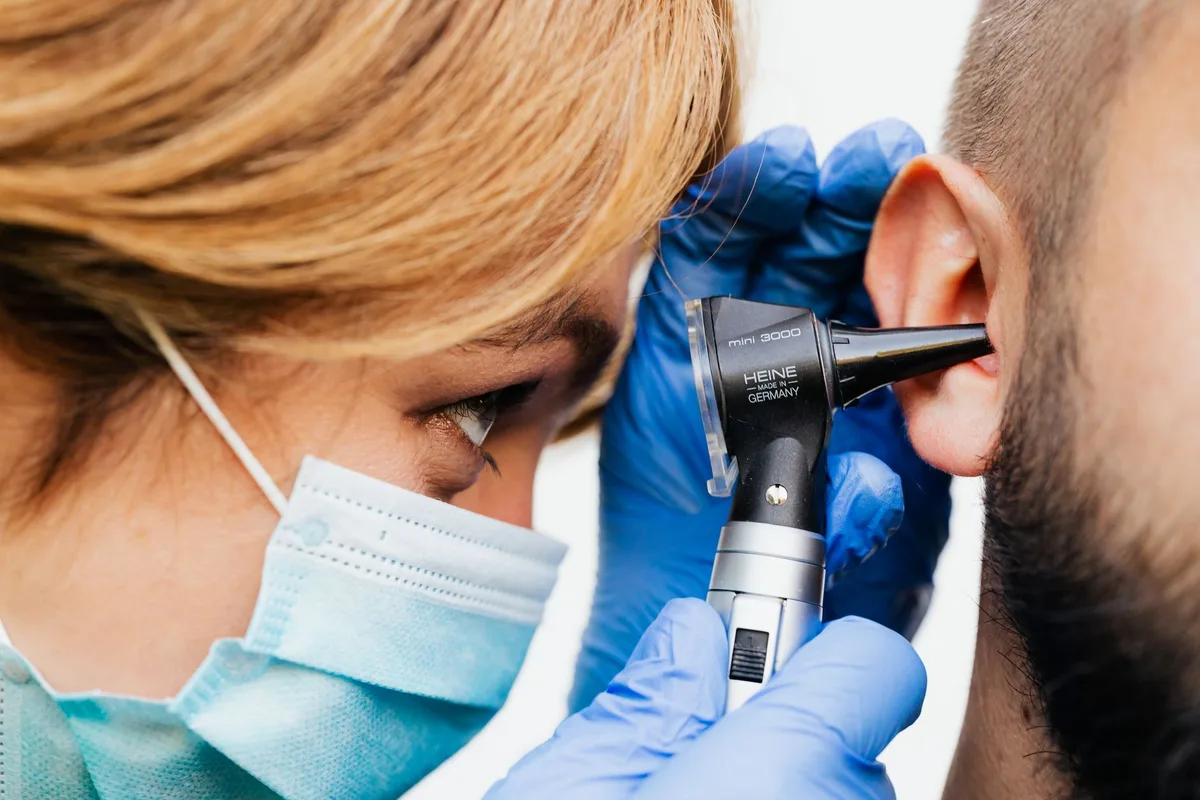
How does peripheral nerve stimulation at the ear work for foot pain?
The outer ear is supplied by branches of several cranial and cervical (neck) nerves. Those branches run straight into brainstem centers that set the volume on pain and on the autonomic nervous system (the body’s automatic controls). Stimulating them reaches the central wiring without going anywhere near the spine. That is the logic of the NS-100 auricular peripheral nerve stimulator: it is not trying to reach your foot. It is trying to reset the processing that has turned a damaged foot into a foot that burns all night. It also tries to nudge the autonomic balance that diabetes pushes toward inflammation. The device is a small FDA-cleared Class II stimulator. Four tiny electrode arrays are placed through the skin at the ear, in a visit of about half an hour under topical anesthetic. They connect to a coin-sized generator behind the ear and are worn for a 20-day protocol. Then everything comes off. Nothing stays implanted, no sedation is used, and there is no activity restriction: you drive home, you work the next shift, you sleep on it.
What painful diabetic neuropathy actually is
Roughly half of people with diabetes develop neuropathy over the course of the disease, according to the American Diabetes Association’s 2017 position statement. For some, the numbness turns into pain. Two biological drivers run it. Years of high glucose glycate (sugar-coat) the proteins inside the nerve and drive oxidative stress in the axon. So the longest nerves, the ones to the feet, fail first. Meanwhile the tiny vessels feeding the nerve stiffen and narrow under insulin resistance. So the nerve is both poisoned and starved. The third driver is social, and it is why a pain clinic asks about your schedule. A refinery or warehouse rotation breaks sleep and hands you cheap carbohydrate at 3 a.m. A fifty-mile round trip replaced the walk. In some towns the nearest fresh produce is a highway exit away. Neuropathy is not a foot problem. It is the first place the terrain becomes impossible to ignore.
Does peripheral nerve stimulation work for diabetic neuropathy?
The published evidence for the ear device is thin, and we will say so. A 2025 paper in Frontiers in Neuroscience reported a retrospective, uncontrolled chart review of 83 Native American patients. They had type 2 diabetes and severe neuropathic pain, with pain scores of at least seven out of ten. They were treated with the combined auricular and cervical stimulation. Average pain fell from about 7.9 to about 1.0 at 90 days. HbA1c fell substantially over the same period. The authors themselves name placebo response and regression to the mean as confounders they could not exclude. They call for a double-blind randomized trial, which has not yet been published. What older literature does establish is that electrical stimulation has a track record here. A 2000 randomized crossover trial in Diabetes Care found percutaneous electrical nerve stimulation to the legs reduced diabetic neuropathic pain against sham. That was a different device at a different site, on the same principle.
The practice position: the device is reversible and low-risk, and it competes with nothing else you are doing. It sits inside a metabolic program, not instead of one. We offer it to patients whose feet burn despite the drugs, who cannot take time off, and who understand that the evidence is early. Results are reported to you with the study design named, never as a bare number.
What is a peripheral nerve stimulator lead, and when is it used?
The lead-based version is what most pain clinics mean by the name. A fine wire is placed under ultrasound or X-ray alongside one nerve that is causing pain. That might be an occipital nerve at the back of the skull, the genicular nerves around a knee, a cluneal nerve over the buttock, or a nerve caught in surgical scar. A temporary sixty-day lead is threaded through the skin and then withdrawn. A 2019 randomized placebo-controlled trial in post-amputation pain found most patients with the active lead reached substantial relief. The twelve-month follow-up showed it outlasting the lead. A permanent version pairs the lead with a small implanted generator. Either way you are awake under local anesthetic, no sedation, because your report of where you feel the stimulation places the lead, and you drive yourself home. Usually the nerve has already been identified by a diagnostic block, as on our occipital nerve block and genicular nerve block pages. One lead is for one nerve. Pain across a region is a spinal cord stimulation conversation.
What does a peripheral nerve stimulator feel like?
EXPECTED
Mild soreness at the electrode sites for a day or two. Awareness of the device when you lie on that side. Pain scores that move over weeks rather than hours. Sleep often improves before the daytime burning does.
UNCOMMON
Skin irritation under the adhesive, or an electrode that works loose after a hard hat or a helmet. Call. It is reseated in minutes and does not reset the clock.
CALL THE SAME DAY
Spreading redness, warmth or drainage at an electrode site, or fever. Rare, and the device comes off if it happens. A foot that goes numb, cold or dusky (gray-blue) is a circulation emergency in a diabetic. It is on the emergency page.
The visit plan from the Illinois side
Two visits: placement, and removal about 20 days later, with a phone check between. No driver to arrange, no shift to cover, which is the point. With clear roads and no traffic figured in, East St. Louis is about 20 minutes from the office, Granite City about 25, Highland about 55. The bloodwork, the food plan and the sleep work start at the first visit and run past the twenty days. The device is the part that comes off.
What happens when the ear stimulator is placed?
- Baseline. Pain by time of day, sleep, walking distance, morning glucose, current medications.
- Ear cleaned and numbed with topical anesthetic. Seated, awake, about half an hour in total.
- Electrode arrays placed. Four tiny arrays go through the skin at mapped points on the ear. They are secured with adhesive and connected to the generator behind the ear.
- Switched on and checked. You may feel a faint tapping or nothing at all. The stimulation is pre-programmed, and there is nothing to adjust.
- Home, and back to normal. No sedation, no restrictions; drive, work, sleep. Keep the site dry as instructed. Return at about 20 days for removal and a written comparison against the baseline.
Frequently asked questions
Is this the same thing as a spinal cord stimulator?
A spinal cord stimulator is an implanted system with a lead over the cord and a generator under the skin, while the ear device is external, temporary and needs no sedation; they are different tools for different stages of the same problem.
Why not put the stimulator on my foot where it hurts?
The burning in a diabetic foot comes as much from central processing as from the nerve endings. The ear reaches that processing directly. How a damaged peripheral nerve turns into a sensitized nervous system is explained on our peripheral neuropathy page.
Does it do anything for my blood sugar?
The one published series reported HbA1c falling alongside pain, in an uncontrolled group also being treated for diabetes. So we treat that as a signal, not a claim, and measure your own numbers. That is why a pain clinic checks your blood sugar at all.
What happens after the twenty days?
The device comes off and the metabolic program stays on, because the glycation and microvascular (tiny vessel) damage behind the neuropathy are still driven by the terrain described on metabolic health and pain. Relief that outlasts the device is the goal.
How long does a peripheral nerve stimulator last?
It depends on which device. The ear stimulator is worn for about 20 days and then removed; nothing stays implanted. The temporary lead placed beside one nerve stays in for sixty days and is then withdrawn. In the amputation-pain trial, the relief outlasted the lead at twelve months. A permanent version pairs the lead with a small implanted generator.
What are the risks of a peripheral nerve stimulator?
For the ear device, expect mild soreness at the electrode sites for a day or two. Less often, the adhesive irritates the skin or an electrode works loose after a hard hat or helmet, and it is reseated in minutes. Rare but urgent: spreading redness, warmth or drainage at a site, or fever. Then the device comes off. No sedation is used and nothing stays implanted.
What is the best treatment for diabetic neuropathy in the feet?
No single device fixes it, because the damage comes from high glucose, insulin resistance and the stiffened vessels feeding the nerve. The bloodwork, the food plan and the sleep work start at the first visit. The ear stimulator is offered to patients whose feet still burn despite medication. It is one part of that metabolic program, never instead of it.
Related reading
- Peripheral neuropathy
- Metabolic health and pain
- Spinal cord stimulation
- Occipital nerve block
- Genicular nerve block
- Why a pain clinic checks your blood sugar
You will be told which device we mean, what the evidence is, and what comes off at the end
Neither version of this treatment is offered as the answer to neuropathy on its own. If your feet burn and your schedule cannot bend, you will hear plainly what the ear device can and cannot be expected to do, with the bloodwork on the table at the same visit.
505 Buckeye Dr, Suite 200
Troy, IL 62294
Procedure clinic: 4499 Woodson Rd, St. Louis, MO 63134, off I-70 next to St. Louis Lambert International Airport. One bridge from the Metro East.
Sources
- Staats PS et al. Combined minimally invasive vagal cranial nerve and trigeminocervical complex peripheral nerve stimulation produces prolonged improvement of severe painful peripheral neuropathy and hyperglycemia in type 2 diabetes. Frontiers in Neuroscience, 2025. PubMed 40933195
- Pop-Busui R et al. Diabetic Neuropathy: A Position Statement by the American Diabetes Association. Diabetes Care, 2017. PubMed 27999003
- Hamza MA et al. Percutaneous electrical nerve stimulation: a novel analgesic therapy for diabetic neuropathic pain. Diabetes Care, 2000. PubMed 10868867
- Gilmore C et al. Percutaneous peripheral nerve stimulation for the treatment of chronic neuropathic postamputation pain: a multicenter, randomized, placebo-controlled trial. Regional Anesthesia and Pain Medicine, 2019. PubMed 30954936
- Gilmore CA et al. Percutaneous 60-day peripheral nerve stimulation implant provides sustained relief of chronic pain following amputation: 12-month follow-up of a randomized, double-blind, placebo-controlled trial. Regional Anesthesia and Pain Medicine, 2019. PubMed 31740443