Pain management · Maryville, IL
The consultation is across the river. If your case ever needs an operating room, it can be done in Maryville, by the same physician.
The first visit for a Maryville patient happens at the St. Louis clinic, one bridge west. That is where the examination and nearly all image-guided procedures are done. Dr. Gurpreet Singh Padda, MD, MBA, MHP holds full privileges at Anderson Hospital in Maryville. So a case that moves up to an implant or an operating-room procedure stays with the physician who made the diagnosis.
Is there a pain management office in Maryville?
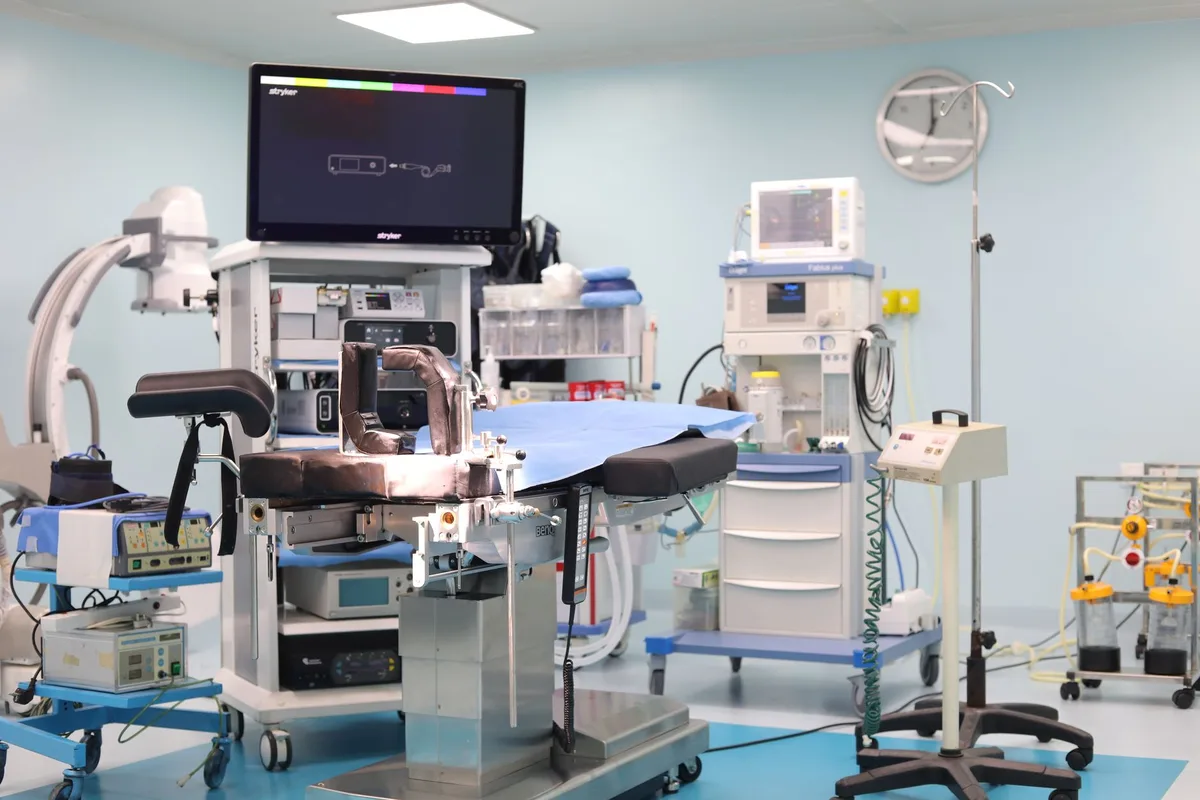
Anderson Hospital sits on Route 162 in Maryville, and Dr. Padda is on its medical staff with full privileges in pain management, anesthesiology, surgery and addiction medicine. That sentence is doing specific work, so read it closely. It does not mean there is a Maryville office. The Illinois office is a few minutes east in Troy, at 505 Buckeye Dr, Suite 200. Nearly all image-guided procedures happen at 4499 Woodson Rd in St. Louis, one bridge west. It means this: when a case needs a hospital, the hospital is in your town. And the physician walking into it is the one who examined you, did your diagnostic blocks and wrote your plan.
Most Maryville patients will never need that sentence. It exists for the few who do. For them it is the difference between continuity and a hand-off inside a system that has never met them.
Where are pain procedures done for Maryville patients?
THE OFFICE, ACROSS THE RIVER
Diagnostic medial branch blocks, epidural and transforaminal injections, radiofrequency ablation, sacroiliac and genicular work, image-guided joint injections. This is where almost every Maryville patient starts and where most finish. Each one is done under fluoroscopy (live X-ray), with contrast confirming placement.
THE TRIAL, STILL IN THE OFFICE
A spinal cord stimulation trial places temporary leads through a needle. Then you go home for about a week to live with the device on. You try it before you commit to it. The trial is judged against a stated target: at least half of your pain gone, and function measurably back. A trial that fails is information, not a failure of the patient.
THE HOSPITAL, IN MARYVILLE
A permanent stimulator implant, an intrathecal pump, a kyphoplasty for a painful compression fracture, or a nerve decompression can be done at Anderson under Dr. Padda’s privileges. Same physician, same plan, your side of the river.
Does spinal cord stimulation work?
Spinal cord stimulation has better randomized evidence than most people assume. It also has narrower uses than most people are told. The multicenter PROCESS trial randomized patients with failed back surgery syndrome and mostly leg pain to stimulation plus medical management, or to medical management alone. At six months, close to half of the stimulation group reached the fifty-percent-relief mark. Under one in ten of the controls did. The SENZA trial then compared 10-kHz high-frequency stimulation with the older paresthesia-based (tingling) devices in patients with chronic back and leg pain. The high-frequency device was superior for both, with back-pain responder rates roughly double. Who was in both trials matters: back-surgery patients with a clear neuropathic (nerve-driven) part, not widespread nociplastic pain (pain from a turned-up nervous system). The device is not offered for the latter here.
Balloon kyphoplasty was tested in the FREE trial. Three hundred patients with acute painful vertebral compression fractures were randomized against nonsurgical care. Kyphoplasty improved function and quality of life at one month. The gap between the groups narrowed over the next year as the nonsurgical group healed. That is the honest shape of the evidence. It is a procedure that shortens a painful stretch in the right fracture. It is chosen for the patient who cannot afford to spend that stretch lying still, and lying still in an older spine has its own death rate. The intrathecal pump sits under the Polyanalgesic Consensus Conference guidance on patient selection, trialing and dosing. It is saved for pain that has used up the rest of the ladder.
Why does back pain continue after spinal fusion?
The ladder is only worth describing if you understand why it is rarely climbed. Persistent pain after a fusion has at least three drivers, and the hardware is usually not one of them. First, scar and extra load on the segments above and below the fusion. Second, a metabolically inflamed body that heals slowly and hurts more. Third, a nervous system that has spent years being told nothing else can be done. That is a lesson the spinal cord learns. The first two are why bloodwork is ordered at a spine visit. The third is why the practice employs its own licensed, pain-trained behavioral clinician to deliver Acceptance and Commitment Therapy, rather than referring it out. Forty to fifty percent of the protocol is that work. A stimulator implanted into a patient who has not done it is being asked to hold back a whole-body process on its own.
Among arriving patients here, the average opioid dose is more than 90 MME per day after two and a half years of pain. Under interventional treatment, 21% are fully weaned within 90 days and 34% within a year. Practice-reported figures from our own population, not trial outcomes, and individual results vary. The ladder is how that happens, and the hospital rung is the least used.
Route 162 to the river, and back again
From the center of Maryville the clinic is about 28.1 miles and roughly 40 minutes of free-flow driving, no traffic modeled. Take Route 162 west to I-55/70 and over the Stan Musial Veterans Memorial Bridge to I-70 west. Or take Route 159 north to I-270 and over the Chain of Rocks to I-170. Either way you exit at Woodson Rd next to Lambert Airport. A hospital procedure reverses the direction. The pre-operative visit and the plan are done across the river. The implant is done at Anderson. The follow-up can often be done by video where it is clinically appropriate, so that the long drives are the ones that carry a procedure.
What continuity is worth
A health system moves a spine patient from the pain clinic to the surgical consult to the nurse practitioner running the device clinic. Each of those people meets you for the first time with a chart they have not read. The independent-practice choice is not a smaller version of that. It is one physician who knows what your diagnostic blocks showed and what your fasting insulin was. One who knows what you told the behavioral clinician about the job you are afraid to lose. And that physician stands in the operating room in your own town. The credential is the license and the privileges. The value is the continuity.
Frequently asked questions
Can my first visit be at Anderson Hospital in Maryville?
The first visit happens at 4499 Woodson Rd in St. Louis, where the examination and diagnostic work are done. The hospital privileges cover implants and operating-room procedures that come later. For Illinois patients sets out which procedures happen where.
What procedures can be done at Anderson under Dr. Padda’s privileges?
Permanent stimulator implants, intrathecal pump placement, kyphoplasty and nerve decompressions. The trial that comes before an implant is office-based. The spinal cord stimulation page explains how the trial is judged.
Do I have to try a stimulator before committing to one?
A trial with temporary leads comes first in every case. It is judged against at least fifty percent relief and measurable function. A trial that misses that bar ends the conversation. The pump pathway on intrathecal pump works the same way.
How long is the drive from Maryville?
About 28 miles and roughly 40 minutes at free-flow speeds, by Route 162 to I-55/70 or Route 159 to I-270. The arrival details and parking are on the contact page.
Will my Maryville primary care physician be kept in the loop?
Every visit creates a note that goes back to the referring or primary physician. Hospital procedures at Anderson are documented in that system as well. How referrals and records move is on for physicians.
What are the treatment options for chronic pain?
Most patients start and finish in the office. That means diagnostic medial branch blocks, epidural and transforaminal injections, radiofrequency ablation, sacroiliac and genicular work and image-guided joint injections, each under fluoroscopy. Above that sits a spinal cord stimulation trial. Then a permanent implant, an intrathecal pump, a kyphoplasty or a nerve decompression at Anderson Hospital. Alongside all of it, forty to fifty percent of the protocol is Acceptance and Commitment Therapy and metabolic work.
Why don’t doctors take my pain seriously?
Often it is the system, not the doctor. A health system moves a spine patient from the pain clinic to the surgical consult to the device clinic. Each person meets you for the first time with a chart they have not read. After years of hearing that nothing else can be done, the spinal cord learns that lesson too. Here one physician keeps your block results, your fasting insulin and your plan.
Can pain management help me get off opioids?
It can. Patients arriving here average more than 90 MME per day after two and a half years of pain. Under interventional treatment, 21% of them are fully weaned within 90 days and 34% within a year. These are practice-reported figures from our own population, not trial outcomes, and individual results vary. The procedures, the behavioral work and the metabolic work are how that happens.
Related reading
- Spinal cord stimulation
- Intrathecal pump
- Kyphoplasty
- Failed back surgery syndrome
- Pain management in Glen Carbon
- Pain management in Troy
The physician who makes the diagnosis is the one who will still be there if the case escalates
Call from Maryville with what has been tried and what the last surgeon said. We will tell you where on the ladder you are, and whether the hospital rung is even in the conversation.
505 Buckeye Dr, Suite 200
Troy, IL 62294
Procedure clinic: 4499 Woodson Rd, St. Louis, MO 63134, off I-70 next to St. Louis Lambert International Airport. One bridge from the Metro East.
Sources
- Kumar K et al. Spinal cord stimulation versus conventional medical management for neuropathic pain: a multicentre randomised controlled trial in patients with failed back surgery syndrome. Pain, 2007. PubMed 17845835
- Kapural L et al. Novel 10-kHz High-frequency Therapy (HF10 Therapy) Is Superior to Traditional Low-frequency Spinal Cord Stimulation for the Treatment of Chronic Back and Leg Pain: The SENZA-RCT Randomized Controlled Trial. Anesthesiology, 2015. PubMed 26218762
- Deer TR et al. The Polyanalgesic Consensus Conference (PACC): Recommendations on Intrathecal Drug Infusion Systems Best Practices and Guidelines. Neuromodulation, 2017. PubMed 28042904
- Wardlaw D et al. Efficacy and safety of balloon kyphoplasty compared with non-surgical care for vertebral compression fracture (FREE): a randomised controlled trial. The Lancet, 2009. PubMed 19246088